
Relieve Compaction, Unlock a Healthier Lawn
Liquid aeration treatments that help water, air, and nutrients reach the root zone of Ormond Beach and Volusia County lawns.
Start Here
Four signs your lawn is fighting the soil, not the fertilizer
Compaction looks like a dozen other problems. Before you spend money on more product, walk the yard and check for these.
Water runs off instead of soaking in
You run a zone for its usual time and the water sheets toward the driveway or sits in low spots, while soil an inch down is still dry. Compacted ground has lost the pore space water moves through.
Thin strips where people and mowers travel
The path from the driveway to the front door, the strip along the fence, the turn the mower makes every week. Those lanes thin out first, because that is where the soil is packed tightest.
A spongy layer above the soil
Press down and the lawn feels like carpet padding. That is thatch, a mat of old stems and runners between the green blades and the dirt. It keeps water and treatment off the roots and holds moisture against the crown, where disease starts.
Shallow roots and a lawn that wilts fast
Grass in compacted soil roots shallow because it cannot push deeper. It browns within a day or two of a missed irrigation cycle and is slow to recover, even on a good fertilization program.
A Liquid Soil-Conditioning Treatment
Relief for Florida’s Compacted Soil
More From Every Treatment
Works Alongside Your Lawn Care Plan
Straight Answers
How liquid aeration compares to pulling cores
Most aeration advice online was written for northern lawns. Here is the honest version for Florida warm-season turf.
Two different tools for the same problem
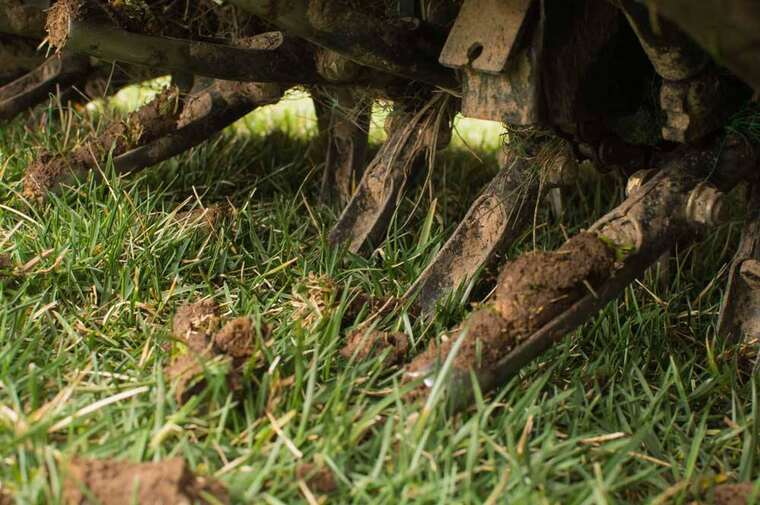
Core aeration pulls plugs of soil and thatch out of the ground with a machine. It leaves those plugs on the lawn for a week or two, and on warm-season grass it can only be done while the turf is growing and able to heal, which rules out winter dormancy here.
Liquid aeration works on the soil rather than mechanically. The solution moves down through the profile and helps separate packed particles so air, water, and nutrients can follow. Nothing is torn up, which matters for St. Augustine, a grass that spreads by runners a core machine can damage.
Why aeration is not paired with overseeding here
Up north, aeration and overseeding go together because cool-season lawns are grown from seed and thin out every year. Florida warm-season grasses do not. Bahia and some Bermuda varieties can be seeded, but St. Augustine and most Zoysia cannot. They repair themselves by sending out runners, filling a bare spot in from its edges.
So aeration here is about helping the lawn you already have root deeper and spread, not about starting seedlings. Where a bare spot needs help closing, topdressing to protect the runners is usually the answer, shown before and after on our red sand page.
Aeration FAQs
What to expect from liquid aeration
When is the right time of year for aeration here?
Warm-season grass should be aerated while it is actively growing and able to respond, which in Volusia County means roughly late spring through early fall. Treating a dormant or cold-stressed lawn does little, because the roots are not growing into the space you just opened.
Do I need to do anything before or after?
Water is the main thing. Moist soil lets the treatment move down instead of sitting on a dry, crusted surface, and watering normally afterward carries it through the root zone. Mow on your usual schedule. There are no plugs to rake up, beyond whatever instructions your technician leaves on the slip.
Will my lawn look torn up afterward?
No. No machine passes over the turf, no plugs are scattered across the yard, no lines are cut into the grass. The treatment goes down as a liquid and the lawn looks the same the day after as the day before. What changes is below the surface.
Will it fix my thatch problem?
It helps, but it is not a dethatcher. Opening the soil improves the conditions microbes need to break thatch down over time, and lets water and treatment get past the layer instead of perching on it. A severe layer also needs mowing corrected, since scalping and overfeeding are what build it. Our mowing guide covers the right heights.
How often does a lawn need it?
It depends on traffic and how tight the soil already is. A yard with kids, dogs, a weekly mowing route, and year-round irrigation packs down far faster than a lightly used side yard. Your technician looks at the lawn and tells you when it is worth doing, as part of our broader lawn care program.
Does it replace fertilization or weed control?
No. Think of it as the step that makes everything else work better. Fertilizer that cannot reach the root zone is wasted, and so is irrigation that runs off the surface. Aeration is a large part of why the same fertilization program can produce different results on two lawns on the same street.
Get Started Today
Ready to Help Your Lawn Breathe?
Get a free estimate for liquid aeration and lawn care tailored to your Ormond Beach property – no contracts required.